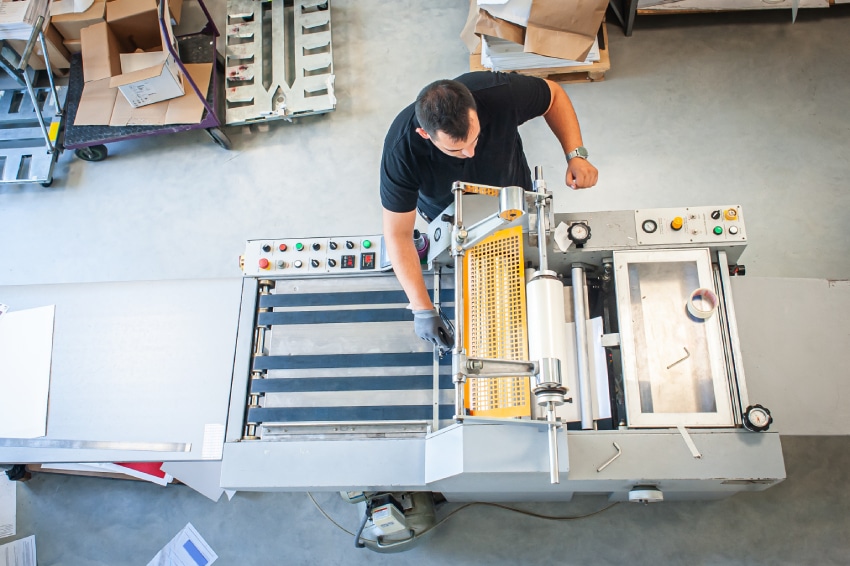
Flatbed Die Cutting for Precision Plastic Components
Flatbed die cutting is one of the most effective ways to produce precise plastic components from sheet material, especially when the part geometry is stable and you need repeatability at production volumes. Because the process uses a press and hardened tooling rather than heat, it works well for many plastics, films, and specialty substrates where edge quality and flatness matter.
For Canadian OEMs, enclosure builders, and electronics suppliers, flatbed die cutting enables fast, consistent production of gaskets, spacers, and other critical parts. In this guide, I’ll walk you through how the process works, when it’s the right fit, and what to consider when it comes to tolerances and material compatibility, especially in demanding sectors like telecom and electronics.
Key Takeaways
- Flatbed die cutting offers efficient production of plastic components in consistent shapes and sizes.
- It supports a range of materials and thicknesses, from rigid sheets to thin films.
- Ideal for mid-to-high volumes, the process balances speed and part accuracy.
- Flatbed systems are well suited to producing die cut gaskets, spacers, and insulation layers.
- Elrex provides industrial die cutting services backed by ISO 9001:2015 quality standards.
Quick Links
- Plastic Sheet Die Cutting for Custom Applications
- When Flatbed Die Cutting Is the Best Choice for Plastic Parts
- Flatbed Die Cutting for Large or Rigid Sheets
- Die Cut Gaskets and Insulation for Electronics and Enclosures
- Plastic Finishing Services That Improve End-Use Quality
- Work With Elrex Manufacturers for Plastic Die Cutting
Plastic Sheet Die Cutting for Custom Applications
When your project calls for parts cut from plastic sheets, flatbed die cutting is the way to go. It’s fast, clean, and reliable. With the right setup, it excels in applications that require tight plastic part tolerances and repeatable quality. The process uses a hydraulic press and steel rule dies to cut through material layers cleanly and efficiently.
From plastic film cutting to thicker materials like ABS or polycarbonate, flatbed die cutting is compatible with a wide range of substrates. At Elrex, we typically recommend this method once you’re past early prototyping and are ready for repeatable production.
Matching Plastic Thickness to Die Type
Different material thicknesses and stiffness levels call for different die designs. For thinner plastics or films, standard steel rule dies often deliver clean cuts at a practical tooling cost. As materials get thicker or denser, we may recommend reinforced tooling, different rule configurations, or controlled cutting strategies to maintain edge quality and dimensional stability.
Before we commit to a die approach, we review your material spec, thickness range, and part features such as tight radii, small holes, and narrow webs. This helps us choose tooling and press settings that cut cleanly without inducing distortion, cracking, or excessive edge deformation.
Common Uses in Enclosures and Spacers
In my experience, flatbed die cutting is especially useful for enclosure builders and electronics teams needing internal layers or insulation pieces that hold up under pressure.
Using flatbed die cutting, we can create plastic parts such as support structures or protective barriers used inside enclosures. This method is also ideal for cutting electrical insulation, light diffusers, and custom spacers. These parts are typically produced with high repeatability, which flatbed systems support efficiently.
When Flatbed Die Cutting Is the Best Choice for Plastic Parts
We recommend flatbed die cutting when speed, repeatability, and flexibility are at the top of your priority list.
Balancing Part Size, Material, and Tolerances
Compared to rotary die cutting, flatbed systems better accommodate larger or thicker die cut plastic sheets. They maintain high edge quality and consistency even as part sizes grow.
This process can also support tight tolerances for many plastic parts without heat input, making it a practical option when tight plastic part tolerances are required and thermal cutting is not ideal.
Material waste is another key factor. Flatbed dies can be laid out efficiently, minimizing scrap and improving cost-effectiveness.
Supporting Both Prototyping and Production Needs
Flatbed die cutting fits well into both early-stage product development and ongoing production. It offers a scalable path forward: use laser or CNC cutting for initial trials, then move to flatbed die cutting once part designs are stable and production volumes increase.
This flexibility supports teams who are working with a leading custom plastic manufacturer and need to bridge between prototyping parts and volume production without incurring tooling costs too early.
Flatbed Die Cutting for Large or Rigid Sheets
Some projects involve plastics that are too thick, rigid, or wide for rotary systems or laser beds. In these cases, die cutting plastic sheets using a flatbed press offers the ideal mix of throughput and part control. Materials like HDPE, PVC, or polycarbonate, common in industrial and telecom enclosures, can be die cut into complex shapes with high dimensional accuracy.
Flatbed die systems allow full-sheet utilization, and can apply consistent pressure over large surfaces, making them suitable for oversized or multi-up cutting layouts.
Die Cut Gaskets and Insulation for Electronics and Enclosures
In many electronics and telecom applications, precision-cut plastic layers act as insulators, vibration dampeners, or sealing barriers. With flatbed die cutting, Elrex can produce these parts quickly and with the precision needed for sensitive electronics.
Die Cut Insulation for Telecom-Grade Plastics
Telecom-grade insulation often involves UL-rated materials like FR4, Kapton®, or UL94-V0 fire-rated plastics. These materials are sensitive to heat and must be processed without distortion, making die cutting preferable over laser-based methods in many applications.
Elrex provides die cutting services for these critical materials with attention to flatness, burr control, and consistent pressure application. Whether you’re sourcing die-cut insulation for signal isolation or environmental sealing, we make sure our flatbed systems deliver consistent, reliable results, built to your exact specifications.
Plastic Finishing Services That Improve End-Use Quality
Flatbed cutting is just one part of the complete production workflow. To ensure parts are ready for use in demanding environments, Elrex also offers plastic finishing services such as:
- Deburring and edge smoothing
- Adhesive backing application
- Lamination or multi-layer bonding
- Hole punching, slotting, or registration marking
These value-added steps ensure that each die cut component arrives production-ready, reducing additional handling and quality control steps downstream.
Work With Elrex Manufacturers for Plastic Die Cutting
As one of Ontario’s trusted plastic component suppliers, Elrex offers precision flatbed die cutting for both rigid and flexible plastics. Our ISO 9001:2015-certified processes support medium and high-volume jobs with consistent output and fast turnarounds.
Whether you’re working on insulation for telecom systems, spacers for enclosures, or layered components for electronics, we’ll help you choose the right plastic fabrication method to meet your performance requirements, tolerance expectations, and production volumes.
We’re proud to support Canadian OEMs and contract manufacturers with reliable, scalable solutions. For custom die cut parts made in Canada with responsive service and documented quality, contact Elrex Manufacturers to start your next project.

About Michael Lambersky
Michael Lambersky is the President of Elrex Manufacturers Inc, delivering high-quality, Canadian-made custom plastic manufacturing solutions. With over 15 years of experience in manufacturing he brings a strong focus on innovation, operational efficiency, and customer-driven solutions.