How Rapid Prototyping with 3D Printing Turns Your Ideas into Products
In today’s competitive market, the ability to move quickly from a design concept to a working product is essential. Rapid prototyping with 3D printing has reshaped how companies develop plastic components. Turning a digital design into a physical prototype helps teams evaluate performance, validate ideas, and refine parts before moving to production. Whether testing a new concept, confirming fit, or preparing for manufacturing, rapid prototyping with 3D printing provides speed, flexibility, and cost efficiency.
This article explains how rapid prototyping works, where it offers advantages, and how combining printing with cutting can support different production needs.
Key Takeaways
- Rapid prototyping with 3D printing speeds up development by converting CAD models directly into physical parts without tooling.
- It reduces cost by eliminating moulds and large minimum-order requirements.
- Combining 3D printing with cutting processes supports both complex shapes and precise flat components.
- Rapid prototyping helps evaluate fit, function, and performance early, reducing risk before production investment.
- Working with an ISO 9001:2015
- -certified manufacturing partner helps ensure consistency and reliability.
Quick Links
From CAD to 3D Printing for Plastic Products
The transition from concept to prototype begins with a digital model. Understanding the CAD to 3D printing workflow helps streamline development. This direct, digital approach eliminates many delays common in conventional prototyping.
The process begins with creating a 3D model in software like SolidWorks, Fusion 360, or AutoCAD. Once the model is complete, it is exported as an STL file and imported into slicing software. The slicer divides the part into layers and sets printing parameters such as layer thickness, infill density, print speed, and support structures.
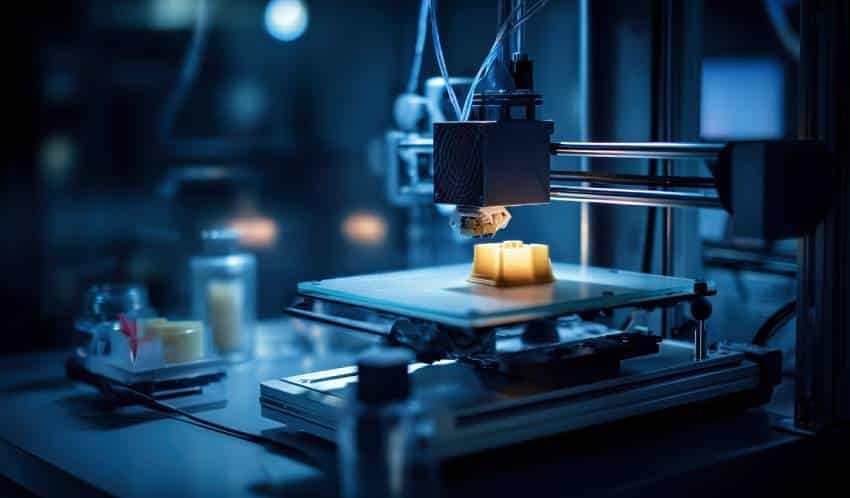
The sliced file is then sent to the printer, which produces the part layer by layer using thermoplastic materials. This workflow provides hands-on control, enabling fast design iterations without tooling or vendor delays.
The Advantages of Rapid Prototyping for Your Plastic Parts
Rapid prototyping has changed product development, offering improvements in speed, cost efficiency, and design validation across every stage of development. Instead of waiting for moulds or external prototyping services, teams can move directly from digital design to a working part, shortening project timelines and allowing for more experimentation.
-
Faster Iteration: Traditional prototyping may take weeks or months. 3D printing reduces that timeline to hours or days. This gives designers the ability to quickly test, review, and revise parts based on real-world feedback. Faster iteration supports innovation: teams can explore multiple variations of a design, compare them side by side, and improve each version based on testing and user input. This speed allows development cycles to progress smoothly rather than stalling while waiting for external vendors.
-
Lower Cost: No upfront tooling means teams can test concepts early without committing to expensive moulds. Prototypes can be produced one at a time, helping avoid waste and reducing financial risk. This is especially important when developing products with uncertain market demand or when exploring early-stage concepts. Rapid prototyping ensures that investment happens only when the design is proven, not before.
-
Better Design Validation: Functional prototypes allow testing of fit, ergonomics, and performance before production. Teams can evaluate how a part interacts with other components, how it feels to handle, or how it performs under load or environmental stress. This hands-on testing helps identify issues early, when they are inexpensive to correct.
This iterative approach reduces risk, improves product quality, and enables development teams to move forward with greater confidence. Rapid prototyping provides a practical way to refine ideas, verify functionality, and prepare products for successful production.
Custom Prototyping: Combining Cutting and 3D Printing
While 3D printing is ideal for complex shapes, other methods play important roles in prototyping and short-run production.
2: When 3D Printing Isn’t Enough: Adding Other Processes to the Workflow
Cutting processes like laser cutting are well suited for flat components, precise outlines, and repeated shapes. 3D printing complements cutting by producing housings, brackets, and parts with internal features or complex contours.
By using both methods together, manufacturers can create assemblies that balance precision with geometric freedom. When these capabilities are available within one facility, production is more efficient, consistent, and coordinated.
Which Industries Gain from Plastic Prototyping?
Rapid prototyping supports a wide range of sectors:
- Industrial manufacturing – testing components and assemblies.
- Automotive – interior components, housings, and brackets.
- Aerospace – lightweight parts for design validation.
- Consumer products – quick iteration for design feedback cycles.
- Electronics – enclosures, mounts, and fixtures.
- Medical and dental – guides, device components, and custom fit parts.
- Education and research – concept testing and project development.
Any industry developing physical components can benefit from the speed and adaptability of rapid prototyping.
Get Your Plastic Parts into Production
Moving from prototype to production is a key milestone. Our role is to support that transition with accurate, repeatable manufacturing processes.
Elrex Manufacturers can assist with cutting and 3D printing for fast, high quality production. We combine 3D printing and cutting capabilities in-house to provide:
- Consistent part quality
- Faster lead times
- Reduced logistics and vendor coordination
- Support across prototyping and short-run manufacturing
Our ISO 9001:2015-certified quality system ensures that every part meets documented standards for accuracy, material quality, and performance.
We support engineers and product developers throughout Ontario and across Canada, helping teams move from prototype to production confidently and efficiently.
If you’re ready to begin, explore our rapid prototyping and 3D printing services or request a quote to discuss your project.
If you are ready to explore how rapid prototyping with 3D printing can accelerate your development, learn more about our industrial prototyping services and 3D printing services. As a leading custom plastic manufacturer, we are here to help you bring your ideas to life. Contact Elrex Manufacturers today to discuss your project.

About Michael Lambersky
Michael Lambersky is the President of Elrex Manufacturers Inc, delivering high-quality, Canadian-made custom plastic manufacturing solutions. With over 15 years of experience in manufacturing he brings a strong focus on innovation, operational efficiency, and customer-driven solutions.