What is Die Cutting and How is It Used in Manufacturing?
Manufacturing organizations evaluating precision component production often ask, “what is die cutting” and how does the process support modern industrial manufacturing. Die cutting is a highly efficient production method used to cut, shape, and convert materials into repeatable parts for industrial applications.
In plastic manufacturing environments, die cutting supports the production of gaskets, seals, films, labels, insulation materials, protective components, and engineered plastic parts. The process is widely used across industries including telecom, defence, aerospace, automotive, electronics, and industrial equipment manufacturing.
For organizations requiring scalable production support, die cutting services provide repeatability, production efficiency, and dimensional consistency within controlled manufacturing workflows.
Key Takeaways
- Die cutting is a manufacturing process used to cut plastics, films, foams, labels, insulation, and other materials into consistent shapes for industrial components. It is commonly used to produce gaskets, seals, spacers, protective layers, and assembly parts.
- Steel rule die cutting is suited to repeatable sheet-material production, while rotary die cutting supports high-throughput roll-fed materials. Laser die cutting can create complex profiles without physical tooling but may not suit heat-sensitive materials.
- Material thickness, flexibility, hardness, temperature resistance, chemical exposure, and assembly requirements all influence whether die cutting is appropriate.
- Die cutting supports efficient high-volume production by reducing cycle times, improving material use, and limiting manual variation.
- Die cutting is generally best for thin, flexible, or adhesive-backed components, while CNC cutting may be better for thicker, rigid parts or components requiring machined features. Manufacturers may use both processes within the same production program.
Quick Links
What Is Die Cutting In Manufacturing?
In manufacturing, die cutting is used to cut materials into defined shapes using a specialized cutting tool or controlled cutting system. A die is the tool or cutting form used to create the required shape, profile, opening, or component geometry.
The process can be used for plastics, films, foams, rubber-like materials, adhesive-backed sheets, labels, insulation materials, and other industrial substrates. Manufacturers also need to consider material and production factors to ensure the final component meets quality and performance requirements.
How die cutting works depends on the selected method. Some systems use pressure and tooling. Others use rotary tooling or laser energy. The right option depends on material thickness, part geometry, production volume, edge requirements, and whether the finished part will be used on its own or as part of a larger assembly.
In repeat manufacturing, die cutting is commonly used for gaskets, seals, spacers, films, labels, protective layers, electrical insulation, masking components, and plastic parts that must be produced consistently over time.
Types Of Die Cutting Used In Manufacturing
Different types of die cutting are used depending on the material, production volume, tolerance requirements, and part complexity. In industrial manufacturing, the most common methods include steel rule die cutting, rotary die cutting, and laser die cutting.
Choosing the right process involves more than selecting the fastest cutting method. An experienced manufacturer will review material performance, edge finish, tool design, part nesting, dimensional stability, production repeatability, and how the finished component will be handled during assembly.
Steel Rule Die Cutting
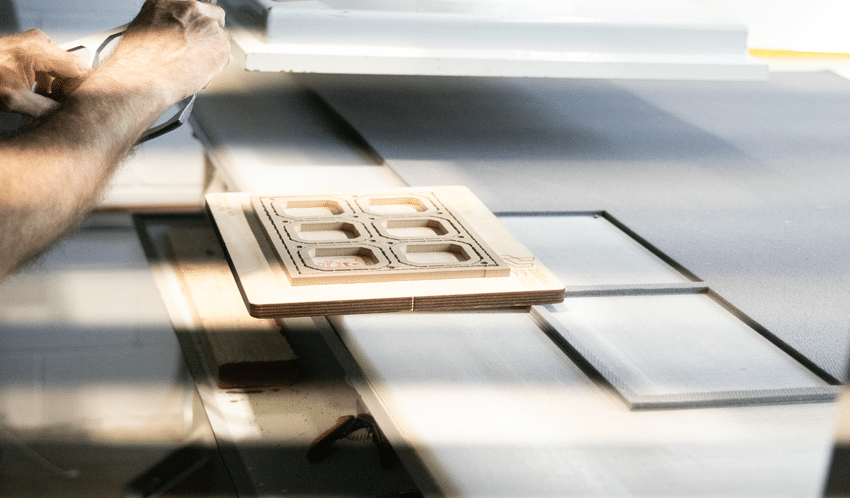
Steel rule die cutting is a widely used method for cutting sheet materials into repeatable shapes. It uses a sharpened steel blade formed into the required geometry and mounted into a die board. The die is then pressed into the material to create the finished part.
Flatbed die cutting is often associated with steel rule tooling. It is well suited for plastic sheets, foams, gaskets, protective liners, insulation components, and other materials that require consistent geometry across production runs.
This method is useful when components need to be produced repeatedly with efficient tooling and predictable results. It is often used for industrial parts where consistency, material yield, and production efficiency matter.
For manufacturers without internal plastic converting capabilities, steel rule die cutting offers a practical way to source repeatable components without managing tooling, setup, inspection, and material handling in-house.
Rotary Die Cutting
Rotary die cutting uses cylindrical tooling to cut material as it moves continuously through a production system. It is commonly used for roll-fed materials, adhesive-backed products, films, laminates, labels, and flexible materials that need to be converted efficiently.
This method is typically used in higher-throughput production environments where continuous processing and repeatable part geometry are important. Semi-rotary die cutting may also be used when greater flexibility is needed for certain repeat lengths or material formats.
Rotary die cutting is especially relevant for die cut labels, membrane materials, technical films, adhesive layers, and flexible industrial components. When the material format and part design are well suited to continuous converting, it can improve production efficiency.
As with any manufacturing process, rotary die cutting should be selected only after reviewing material compatibility, tooling requirements, registration accuracy, waste management, and inspection needs.
Please note that Elrex Manufacturers does not offer rotary die cutting. This process is generally reserved for continuous converting applications involving roll-fed or flexible substrates, where cylindrical tooling, repeatable geometry, and high-throughput production are required. Elrex instead supports other cutting and fabrication processes that are better suited to its manufacturing setup, material handling capabilities, and part specifications.
Laser Die Cutting
Laser die cutting uses focused laser energy to cut material without traditional physical cutting dies. This process can support complex geometries, reduce tooling requirements, and make design changes easier in some applications.
Laser die cutting may be suitable for thin plastics, films, labels, technical insulation components, and detailed part profiles. However, not every material is a good fit. Heat sensitivity, edge quality, discolouration, and cut performance can vary depending on the substrate.
In an experienced manufacturing environment, laser die cutting is evaluated alongside other options. For some parts, CNC cutting, steel rule die cutting, or plastic fabrication may offer a better balance of accuracy, throughput, cost control, and long-term repeatability.
Materials Used In Die Cutting For Plastic Parts
Material selection is one of the most important factors in any die cutting project. The chosen material affects cut quality, dimensional stability, edge finish, compression behaviour, adhesive performance, handling, and long-term component reliability.
When procurement or engineering teams ask what materials can be die cut, the practical answer depends on material thickness, flexibility, hardness, heat sensitivity, application environment, and required production volume.
An experienced custom plastic manufacturer can help determine whether die cutting is the right process, or whether CNC cutting, routing, laser cutting, or fabrication would be better suited to the component.
Plastics Used In Die Cutting
Many plastics can be die cut, depending on their thickness, rigidity, and application requirements. Common materials used in plastic die cutting may include PETG, polycarbonate, ABS, PVC, HDPE, UHMW, acrylic, nylon, polyethylene films, expanded PVC, and other industrial plastics.
In production manufacturing, die cut plastics are often used for protective covers, spacers, insulation components, interface layers, seals, barriers, and assembly support parts. The process is especially useful when the same component must be produced repeatedly with accurate dimensions and predictable performance.
Material selection should consider the full application, not just the cutting process. Factors such as temperature exposure, chemical contact, flexibility, electrical requirements, impact resistance, and assembly method can all affect whether a plastic is suitable for die cutting.
Flexible Materials In Die Cutting
Flexible materials are commonly used in die cutting because they can often be processed efficiently into repeatable shapes. These materials may include foam, rubber-like materials, silicone, felt, films, adhesive laminates, membrane materials, and protective layers.
Flexible die cut components are often used for sealing, cushioning, vibration control, insulation, masking, spacing, and protection. In industrial assemblies, these parts may look simple, but their performance can be critical to fit, durability, and production consistency.
Expert review is important because flexible materials may stretch, compress, distort, or shift during cutting and assembly. Proper tooling, material handling, part design, and inspection procedures help reduce variation across production runs.
Die Cutting For Gaskets Labels And Films
Die cutting is frequently used for gaskets, labels, and films because these components often require clean geometry, repeatable dimensions, and efficient production.
Gaskets and seals may be used for environmental barriers, compression interfaces, electrical insulation, vibration control, or protective separation between components. Die cut labels may be used for equipment identification, safety labelling, branding, product tracking, and control panel applications.
Films and thin technical materials may require precise cut profiles, consistent registration, and careful handling. In these applications, the die cutting process must account for material movement, adhesive performance, liner selection, and assembly integration.
For manufacturers sourcing gaskets, die cut labels, films, and plastic components, die cutting can support repeatable supply when it is managed through a controlled production workflow.
Advantages Of Die Cutting In Manufacturing
Die cutting offers consistent, repeatable production for plastic and flexible components, improving efficiency and supporting scalable manufacturing. The process ensures parts meet design specifications while reducing manual variation.
High Volume Production
Die cutting is especially valuable when a component must be manufactured repeatedly with consistent geometry, predictable throughput, and controlled quality. Once tooling and process parameters are established, the process can support efficient production across ongoing supply programs.
For high volume production, die cutting can reduce cycle time compared with manual cutting or slower profile-cutting methods. It can also support better material usage when parts are nested and processed efficiently.
This makes die cutting useful for OEM supply chains, metal fabrication partners, electronics manufacturers, telecom applications, automotive components, and other industrial programs that require repeatable plastic or flexible components.
Accuracy and Repeatability
Accuracy and repeatability are key advantages of die cutting in manufacturing. Properly designed tooling allows components to be produced with consistent shape, hole placement, cut profile, and overall dimensions.
Repeatability is especially important when die cut parts are used in assemblies. Gaskets, seals, spacers, labels, films, and insulation components must often align with fasteners, housings, panels, covers, or mating parts.
A controlled die cutting process can support inspection requirements, reduce part variation, and help maintain reliable assembly performance over time. For production work, this consistency is often more important than the cutting method itself.
Die Cutting Compared To CNC Cutting
Die cutting and CNC cutting are both valuable manufacturing processes, but they are not interchangeable in every application. The correct choice depends on material, thickness, geometry, tolerance expectations, production volume, and downstream assembly needs.
Die cutting is often more efficient for repeatable thin-gauge components, films, foams, labels, gaskets, adhesive-backed materials, and flexible parts. CNC cutting may be more suitable for thicker plastic sheet, rigid materials, tighter geometry control, routing operations, or parts requiring machined features.
Elrex Manufacturers can help evaluate which process best supports the material, tolerance, production volume, and assembly requirements of the project. In many industrial supply relationships, die cutting and CNC cutting work together as part of a broader plastic manufacturing strategy.
Die Cutting In Production Manufacturing
In modern production environments, die cutting supports scalable manufacturing by delivering precise, repeatable parts for assemblies. Manufacturers can rely on external suppliers for material selection, cutting method, and inspection requirements, reducing the need for internal tooling and setup. This approach ensures consistent part quality, smooth assembly integration, and reliable supply across ongoing production programs.
Production-Ready Die Cut Plastic Components
Die cutting for plastic parts is commonly used when components need to be thin, repeatable, and efficient to produce. These parts may include plastic insulators, protective covers, interface spacers, electrical barriers, equipment seals, overlays, and assembly support components.
The goal is to produce parts that fit the intended assembly, meet production requirements, and support long-term manufacturing reliability.
Die Cutting For Assembly Parts
Die cut parts are often used inside larger industrial assemblies. These components may provide sealing, spacing, insulation, labelling, masking, vibration reduction, or protective separation between parts.
In assembly environments, small variations can create larger downstream issues. A gasket that does not align properly, a label that does not register correctly, or a spacer that varies in thickness can affect assembly speed and product consistency.
For this reason, die cutting should be planned with the final assembly in mind. Material selection, cut tolerance, adhesive backing, liner choice, and packaging can all affect how efficiently parts move through production.
Die Cutting In Industrial Supply Chains
Modern industrial supply chains require component suppliers that can deliver repeatability, documentation, clear communication, and reliable production support. Die cutting helps manufacturers source precision plastic and flexible components without managing internal cutting or converting capabilities.
For OEMs, procurement teams, and industrial manufacturers, Elrex Manufacturers provides die cutting as part of a broader custom plastic manufacturing offering that supports repeatable production and long-term supply reliability.
With die cutting, CNC machining, plastic fabrication, UV printing, assembly, and engineering collaboration, Elrex supports production programs that require dimensional consistency, reliable supply, and scalable manufacturing support. To discuss production-ready plastic components, contact Elrex Manufacturers.

About Michael Lambersky
Michael Lambersky is the President of Elrex Manufacturers Inc, delivering high-quality, Canadian-made custom plastic manufacturing solutions. With over 15 years of experience in manufacturing he brings a strong focus on innovation, operational efficiency, and customer-driven solutions.