Plastic Sheet Cutting Methods: CNC, Laser, and Die Cutting Compared
Selecting the right plastic sheet cutting process affects part quality, production repeatability, cost, and the final performance of a plastic component. Manufacturers and their engineering, purchasing, and product design teams often need to compare multiple manufacturing options when producing panels, covers, gaskets, enclosures, and other flat plastic parts.
Each cutting method has specific advantages depending on material type, thickness, geometry, production requirements, and tolerance requirements. CNC routing, laser cutting, and die cutting are all effective processes when applied to the right application.
Understanding the differences between these plastic sheet cutting methods helps you choose a process that supports your production requirements rather than creating later manufacturing limitations.
Elrex Manufacturers supports OEMs and industrial organizations with custom plastic component manufacturing from prototyping and product development through ongoing production.
Key Takeaways
- CNC routing, laser cutting, and die cutting each support different plastic component requirements based on part design, material, and production requirements.
- CNC routing is suited for plastic components requiring machined features, controlled dimensions, and complex profiles.
- Laser cutting can provide an efficient option for suitable flat plastic profiles where dedicated cutting tooling is not required.
- Die cutting plastic sheets is commonly used for repeatable production of gaskets, insulation materials, and flat components.
- Selecting the correct manufacturing process early helps reduce production issues and supports consistent component quality.
What Is Plastic Sheet Cutting?
Plastic sheet cutting involves converting plastic sheet materials into finished or semi-finished components using controlled manufacturing processes. The selected method depends on the material, part design, required accuracy, and expected production quantity.
Common applications include equipment covers, electrical panels, machine guards, enclosure components, mounting plates, insulation layers, and protective panels.
When comparing plastic sheet cutting processes, the cutting operation itself is only one consideration. You should also evaluate material performance, edge requirements, dimensional accuracy, repeatability, secondary operations, and how the part will be used in the final assembly.
Different plastics respond differently to cutting methods. Factors such as sheet thickness, flexibility, heat sensitivity, machinability, and surface finish requirements influence the appropriate manufacturing approach.
If you need custom plastic components from prototyping and product development through ongoing production, Elrex provides plastic parts manufacturing services for industrial and OEM applications.
CNC Routing for Plastic Sheet Parts
CNC routing uses programmed cutting tools to remove material and create plastic components with controlled profiles and machined features. Unlike simple profile cutting, CNC routing can produce additional features such as holes, slots, pockets, countersinks, and complex contours.
This makes CNC routing suitable for plastic components that require controlled dimensions or integration with other assemblies.
When Routed Features, Depth, and Dimensional Control Matter
Knowing when to use CNC routing depends on the requirements of the finished part.
CNC routing is often selected when a component requires:
- Precision mounting locations
- Machined openings or recesses
- Multiple features within one component
- Controlled dimensional accuracy
For example, a plastic equipment panel may require mounting holes, access openings, and recessed sections that must align with other components. CNC routing allows these features to be produced as part of a controlled manufacturing process.
Plastic part tolerances should always be considered alongside the function of the component. A protective cover may not require the same accuracy as a mounting plate installed within a mechanical assembly.
The selected plastic can behave differently during machining, and factors such as heat generation, material movement, fixturing, part geometry, and sheet thickness can affect dimensional consistency and edge quality. These are important considerations to review with your manufacturing partner when a component includes multiple machined features or critical dimensions.
Elrex provides plastic CNC services for components requiring accurate routing and repeatable production.
Laser Cutting for Plastic Sheet Parts
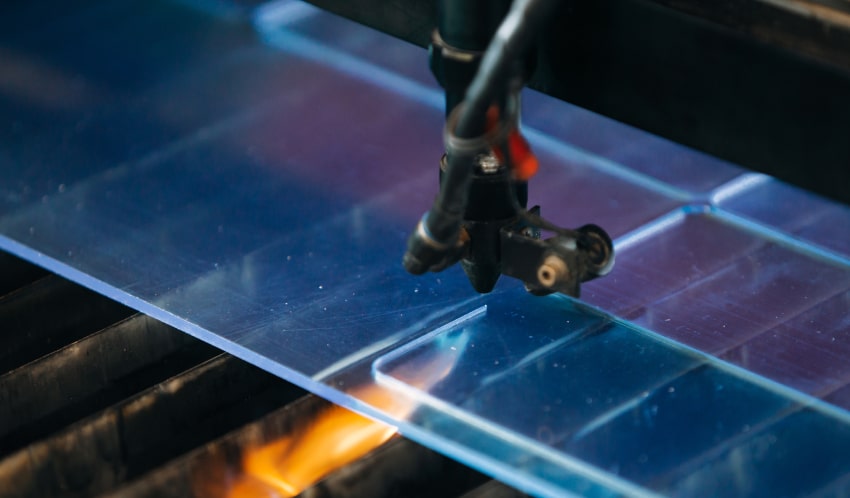
Laser cutting uses a focused beam to cut plastic sheets according to a programmed profile. It can be effective for flat components that require detailed shapes, efficient setup, and design flexibility.
Unlike processes that require dedicated cutting tools, laser cutting can allow production changes without creating new physical tooling.
Detailed Profiles and Tooling-Free Cutting
When reviewing when to use laser cutting, you should consider material type, thickness, edge requirements, and the expected production environment.
Laser cutting can be suitable for:
- Flat panels
- Covers
- Plastic sheet profiles
- Components requiring detailed outlines
The process can provide efficient production for suitable materials, but it is not appropriate for every plastic sheet application. Material compatibility, heat response, edge appearance, sheet thickness, and final part requirements should be reviewed before selecting the process.
Elrex provides laser cutting services in Ottawa for suitable plastic sheet applications.
Die Cutting for Repeatable Flat Plastic Parts
Die cutting uses a shaped cutting tool to produce repeated components from sheet materials. It is commonly used where the same flat component is required consistently over a production run.
This process is often selected for flexible plastics, films, foams, insulation materials, and gasket applications.
Gaskets, Insulation, Films, and Production Quantities
Die cutting plastic sheets is often the right choice when production repeatability and quantity requirements justify dedicated tooling.
Common applications include:
- Sealing gaskets
- Protective films
- Insulation components
- Flat covers and pads
Once tooling is created, die cutting can deliver consistent results across repeated production orders.
Higher quantities can help justify tooling investment, while applications with changing designs may benefit from CNC routing or laser cutting, depending on the material and part requirements.
Elrex provides die-cutting services for production applications requiring repeatable flat plastic components.
CNC vs Laser vs Die Cutting: Key Decision Factors
Choosing between CNC routing, laser cutting, and die cutting requires reviewing the full part requirements.
| Factor | CNC Routing | Laser Cutting | Die Cutting |
|---|---|---|---|
| Best suited for | Plastic parts requiring machined features and controlled dimensions | Flat profiles and detailed sheet cuts | Repeat production of flat components |
| Material considerations | Machinability, dimensional stability, and part requirements | Suitability based on material and heat response | Sheet or flexible materials compatible with the cutting process and tooling |
| Geometry | Complex profiles and added features | Two-dimensional shapes | Repeated production shapes |
| Tolerance control | Suitable for controlled machined dimensions, depending on material and geometry | Depends on material and thickness | Repeatability depends on the tooling, material, and process setup |
| Tooling requirements | No dedicated cutting die required | No cutting die required | Dedicated cutting tool required |
| Production requirements | Product development, validation, bridge production, and ongoing production | Product development, validation, bridge production, and ongoing production where the process is suitable | Repeat production where dedicated tooling is justified |
Material and Thickness
Material selection is one of the first factors to evaluate because a cutting process that performs well with one plastic may not produce the same results with another. Heat sensitivity, dimensional stability, flexibility, machinability, and required edge condition can all influence which process is appropriate.
Thickness also influences process selection. Thin, flexible sheets may require a different approach than rigid plastic plates used for structural or equipment applications. Your manufacturing partner should evaluate the material and thickness against the geometry, tolerances, edge requirements, and performance requirements of your component.
Reviewing these requirements before production helps reduce issues with edge quality, dimensional accuracy, and finished part performance.
Geometry and Tolerance
Part geometry often determines which cutting process is appropriate.
Simple flat profiles may be suitable for laser cutting or die cutting. Components requiring additional machining features may require CNC processing.
Plastic part tolerances should be defined based on how the component functions within the final assembly. Tight tolerances should be specified where they affect fit, performance, or alignment. Applying unnecessarily tight tolerances to non-critical dimensions can add manufacturing complexity without improving component performance.
Tooling and Quantity
Production requirements affect the most practical manufacturing approach.
Processes that do not require dedicated cutting tooling can provide greater flexibility during prototyping, design refinement, or when component designs are expected to change. Once your design is established for ongoing production, you can evaluate whether dedicated tooling may improve repeatability or production efficiency.
Understanding expected quantities early helps ensure the selected process supports both current requirements and future production needs.
Choosing the right plastic sheet cutting method depends on how your material, geometry, tolerances, tooling requirements, and production needs work together. Evaluating these factors early can help you avoid unnecessary process changes and support more consistent manufacturing.
Elrex Manufacturers works with OEMs and manufacturers that need custom plastic components from prototyping and design refinement through ongoing production. If you need a Canadian manufacturing partner for repeatable plastic component production, contact Elrex Manufacturers to discuss your application.

About Michael Lambersky
Michael Lambersky is the President of Elrex Manufacturers Inc, delivering high-quality, Canadian-made custom plastic manufacturing solutions. With over 15 years of experience in manufacturing he brings a strong focus on innovation, operational efficiency, and customer-driven solutions.
See Michael full bio here and follow him on LinkedIn.